15. PTT Safety Architecture (ART 0535)
Principle: Release is more safety-critical than keying. A lost PTT release command can leave a radio transmitting indefinitely — causing harmful interference, overheating the radio, and violating spectrum regulations. Every layer must have an independent path to force RX.
15.1 Safety Model — Defense in Depth
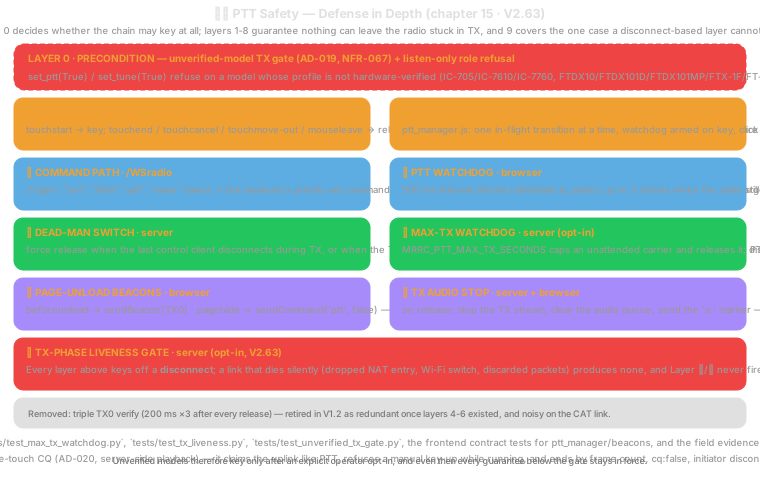
The MRRC Modern PTT safety architecture provides 7 independent layers of defense against stuck-TX scenarios for all supported radio backends, preceded by a configuration precondition (Layer 0) that decides whether the chain may key the radio at all.
| Layer | Location | Mechanism | Failure Mode Caught |
|---|---|---|---|
| 0 | Server (backend, precondition) | Unverified-model transmit gate: set_ptt(True)/set_tune(True) refuse unless MRRC_ALLOW_UNVERIFIED_TX=1; PTT releases are never gated |
Keying a radio whose CAT semantics are documentation-derived rather than measured (AD-019) |
| 1 | Browser UX | Touch-and-hold: release on mouseup/touchend/mouseleave/touchcancel |
User intentionally releasing PTT |
| 2 | Browser → Server | sendCommand('ptt', false) over /WSradio |
Normal network path |
| 3 | Browser | PTT Watchdog: 500ms interval checks radioState.tx_status; up to 3 retries |
TX0 command or state broadcast lost |
| 4 | Server | Dead-man switch: force TX0; when the last control client disconnects during TX, or when the TX-audio owner disconnects during TX. Uplink ownership follows the PTT-ing client (token-matched on key-up, and because one session token is a 30-day cookie the match is resolved to the last-connected socket of that session, never to an arbitrary one), a same-session replacement audio socket supersedes a half-open page-reload socket, a same-session socket that is actually streaming takes the uplink over on its first frame, and a different session cannot steal merely by connecting or by streaming; owner disconnect promotes a remaining client |
Browser crash, tab close, network loss, audio socket drop, multi-client ownership |
| 5 | Browser | beforeunload → navigator.sendBeacon() with TX0 |
Tab/browser close during TX |
| 6 | Browser | pagehide → sendCommand('ptt', false) |
Mobile app switch / backgrounding |
| 7 | Server + Browser | Stop TX audio stream; clear audio queue; wsAudioTX.send('s:') |
Audio continuing to feed radio after release |
| 8 | Server | One-shot CQ call (AD-020): server-side player keys, plays the packaged recording once, then drains and unkeys (stop_tx(graceful=True) → set_ptt(False)). Aborts immediately on cq:false, initiator disconnect, last-client disconnect, external unkey (watchdog/TUNE), or shutdown |
Automated transmission with no operator finger on PTT — every call has a definite end |
| 9 | Server (restart path) | _schedule_restart() releases PTT — run_coroutine_threadsafe(cat.set_ptt(False)), 1.5 s bounded — before os._exit(RESTART_EXIT_CODE), which by design skips the lifespan shutdown and its Force-RX write |
Restarting the app (connection-settings save, cloud-certificate enrolment) while the radio is keyed (field report 2026-10-16) |
The release layers are not the whole story — the process must survive to run them (2026-10-16). Every layer above assumes a live server process. A field report (按发射 → 电台一直发射 → MODERN SERVER 进程消失, Windows 11 + FT-710) showed how the two interact: ptt:true keys the radio before the TX audio stream is opened, and audio_handler.start_tx()’s USB-re-enumeration recovery (_reinit_pyaudio()) called Pa_Terminate() while the RX capture stream was still being read on the event-loop thread — a use-after-free, i.e. a native access violation that kills the process with no Python traceback, so none of Layers 2–9 ever runs and the radio stays keyed. The fix is to close both streams under a lifecycle lock (_stream_lock()) before terminating PortAudio, to take that lock non-blockingly in read_rx_chunk(), and to treat a raised start_tx() as a release trigger in the ptt:true handler. The operational lesson stands regardless: when the process itself can die, the radio’s own Time-Out Timer (TOT) is the only layer that survives it.
Removed layer — Triple TX0 Verify (removed in V1.2, 2026-07-08): earlier releases queried TX; three times at 200ms intervals after every release and re-sent TX0; on non-zero. This added ~600ms to every release, and field observation showed the radio obeys TX0; on the first write (fire-and-forget). Stuck-keyup detection is now covered by the server-side TX-status poll (500ms) feeding the browser PTT watchdog (Layer 3).
15.2 Layer Details
Layer 0 (V2.41, extended V2.46): unverified-model transmit gate. Before any of the layers below can key the radio, the active backend’s set_ptt(True)/set_tune(True) refuse when the model profile is not hardware-verified (IC7300Backend for IC-705/IC-7610/IC-7760, YaesuBackend for FTDX10/FTDX101D/FTDX101MP/FTX-1F/FT-891) unless MRRC_ALLOW_UNVERIFIED_TX=1 is set; the refusal is logged once per process and PTT releases are never gated, so the layers below can always unkey. See AD-019.
Layer 1: Touch-and-Hold UX
PTT only transmits while the user is actively touching the PTT button:
pttBtn.addEventListener('mousedown', handlePTTStart);
pttBtn.addEventListener('touchstart', function(e) { e.preventDefault(); handlePTTStart(); });
pttBtn.addEventListener('mouseup', handlePTTEnd);
pttBtn.addEventListener('touchend', function(e) { e.preventDefault(); handlePTTEnd(); });
pttBtn.addEventListener('mouseleave', handlePTTEnd);
pttBtn.addEventListener('touchcancel', handlePTTEnd);
Layer 2: Normal WebSocket Command
function handlePTTEnd() {
    sendCommand('ptt', false);
    // ...
}
Server receives {"type":"set","field":"ptt","value":false} → sends the backend-specific PTT unkey command (FT-710 CAT TX0;, IC-7300/MK2 CI-V 0x1C 0x00 unkey) fire-and-forget (see removal note in §15.1).
Layer 3: PTT Watchdog (Browser)
// ptt_manager.js
pttVerifyTimer = setInterval(function() {
    if (!pttActive && !tuneActive) {
        if (radioState.tx_status !== 0) {
            retries++;
            sendCommand('ptt', false);
            if (retries >= 3) {
                // Force locally
                radioState.tx_status = 0;
                radioState.is_transmitting = false;
                renderPTTState();
                renderStatusBar();
                stopPTTWatchdog();
            }
        } else {
            stopPTTWatchdog();
        }
    }
}, 500);
The watchdog’s input is the server-side TX-status poll (500ms), which keeps radioState.tx_status fresh even if the release command’s state update was lost. The same ownership/dead-man logic applies to the IC-7300/MK2 backend, where PTT key/unkey is sent as CI-V 0x1C 0x00 frames.
Cross-client false positive (fixed 2026-09-25, SDD I6 PTT half): the watchdog cannot tell “my release did not land” from “another client just keyed” — with two tabs open, the idle tab’s watchdog re-sent ptt:false on the other tab’s key-up and unkeyed the live transmission (field log: 75 TX sessions in 5 minutes, 16 with zero mic frames, three releases 30 ms apart). Two layers now stop this: the server ignores a release from any socket that is not the current keyer (_ptt_key_ws, Layer 4b) and pushes the authoritative tx_status back with ptt_keyed_by_other: true; on that flag the browser calls PTTManager.cancelWatchdog() and stands down instead of retrying.
Layer 4: Dead-Man Switch (Server)
# In /WSradio disconnect handler:
if not ctrl_clients and radio.is_transmitting and backend and backend.connected:
    logger.warning("Last client disconnected during TX! Forcing RX.")
    await backend.set_ptt(False)
    radio.update(tx_status=0)
    if audio:
        audio.stop_tx()
Uplink ownership is per socket, but a session token is not (fixed 2026-10-05, SDD I6 uplink half): the token is a 30-day cookie, so ONE browser session can hold several /WSaudioTX sockets at once — a page reload leaves its predecessor half-open for tens of seconds, and two tabs of one login share the token outright. _claim_tx_owner_for_token() resolved that token by taking the first match scanned out of audio_tx_clients, a set, so the key-up claim was decided by iteration order. Field log 2026-10-05 on a hub instance: the claim landed on the dead predecessor, TX audio ownership → PTT client was logged as usual, and the reloaded page’s every mic frame was then dropped as non-owner — frames=0 non_owner_drops=236, peak=0% (a keyed carrier with no modulation) for 58 s, until the stale socket was reaped and _promote_tx_owner() handed the uplink to the survivor (frames=78 written=72 peak=99%). Two layers now:
- Deterministic claim —
_register_tx_socket()records each socket’s connect order and the key-up claim takes the last-connected socket of that session, which is what “a same-session replacement audio socket supersedes a half-open page-reload socket” always meant; a first-match scan only ever satisfied it by luck. - Streaming takeover —
_same_session_uplink_takeover()hands the uplink to a non-owner socket whose token equals the owner’s, on the first frame it actually streams. This covers the case a connect-time rule cannot: two same-session sockets that are both live, where the operator happens to work in the one that connected first. Self-heals within one 20 ms frame instead of muting the whole transmission.
A different session still cannot steal an active uplink — neither by connecting (_assign_tx_owner_on_connect) nor by streaming at it — because interleaving two microphones into one playback queue is exactly what the single-owner guard exists to prevent. Ownership moving away from a socket also keeps the dead-man switch correct: the finally block only forces RX when the socket that disconnects is the owner (TXUplinkOwnershipTests).
ATR1000 tune assist (server-side TX2 keying): the optional ATR tune assist (_atr_tune_assist(), §9.8) keys a TX2 carrier server-side for up to 45 s (ATR_TUNE deadline). Safety: the carrier drop is guaranteed by a finally block on every exit path (skip/success/rollback/error); the Layer 4 last-client-disconnect dead-man switch still applies while the carrier is up; an SWR≤1.6 gate skips tuning entirely; relays roll back when SWR does not improve. All ATR I/O runs in its own asyncio task — never on the audio path.
Layer 4b: Control-Plane PTT Arbitration (Server)
The TX-audio uplink has had a single owner since V2.4x; the control plane did not — any full-control client could send ptt:false at any time (last-writer-wins, SDD I6). Since 2026-09-25 the socket that sends ptt:true is recorded as _ptt_key_ws, and while it holds the key:
# /WSradio "set ptt" handler:
if not _ptt_release_allowed(ws):        # ws is not the keyer
    # ignore the release, push the authoritative state back:
    await ws.send_text(json.dumps({
        "type": "stateUpdate",
        "fields": {"tx_status": radio.tx_status},
        "dirty": ["tx_status"],
        "ptt_keyed_by_other": True,     # browser watchdog stands down
    }))
return- A key-up from any client is still honored (takeover by re-keying), and the keyer’s own release always passes — the stuck-keyup retry path (Layer 3) is untouched.
_ptt_key_wsis cleared on every server-initiated unkey: normal release, audio-open-failure unkey,MRRC_PTT_MAX_TX_SECONDSwatchdog, /WSaudioTX owner-disconnect force-RX.- Zombie keyer: when the keying control socket disconnects mid-TX the server forces RX immediately — even with other clients still connected (they are not the keyer, and their releases are exactly what the arbitration ignores). Mirrors the /WSaudioTX owner rule.
- Trade-off: while a keyer is connected but unresponsive (browser frozen, socket alive), other clients cannot unkey it; the coverage is the keyer-disconnect rule, the Layer 4 dead-man, and the opt-in
MRRC_PTT_MAX_TX_SECONDSwatchdog. - Tests:
PTTControlArbitrationTests(tests/test_server_ws_protocol.py).
ATR1000 auto full tune (no self-keying): the high-SWR guard (atr1000_client.py, §9.8 behaviour 4) never keys the radio — it only acts while the operator is already transmitting (measured power ≥5 W) and emits nothing but an ATR-1000 tune frame; atr1000_client.py holds no CAT/PTT reference at all (a source-level test pins this). The manual assist’s TX2 carrier path above is unchanged and remains the only ATR-initiated keying, with its finally drop rule.
Layer 5: Beforeunload Beacon
window.addEventListener('beforeunload', function() {
    if (pttActive || tuneActive) {
        if (navigator.sendBeacon) {
            const blob = new Blob([
                JSON.stringify({type:'set', field:'ptt', value:false})
            ], {type: 'application/json'});
            navigator.sendBeacon('/WSradio', blob);
        }
    }
});
Layer 6: Pagehide Handler
window.addEventListener('pagehide', function() {
    if (pttActive || tuneActive) {
        sendCommand('ptt', false);
    }
});
Layer 7: TX Audio Stream Stop
Server-side on PTT release:
if audio:
    audio.stop_tx()
Browser-side on PTT release:
function stopTXAudio() {
    txAudioRunning = false;
    // ...
    if (wsAudioTX && wsAudioTX.readyState === WebSocket.OPEN) {
        wsAudioTX.send('s:');  // Flush server TX queue
    }
}
Layer 8: Server-Side CQ Call (AD-020)
The CQ key transmits without a human holding PTT, so it is the one path where “the operator lets go” cannot be the safety net. Instead the player is the safety net:
- The call is a single finite asset (<= 30 s guard) played once; the player knows the frame count, so
completeis reached by arithmetic, not by a timer. - While it runs, a manual key-up (PTT), a second CQ start, and TUNE are all refused — one carrier, one source.
- Any external release of the carrier (
MRRC_PTT_MAX_TX_SECONDSwatchdog, TUNE, another client, dead-man switch) is observed throughradio.is_transmittingand ends the call asaborted/unkeyed. - The initiator’s disconnect aborts immediately (
reason:"client_gone"), never leaving a bystander’s carrier on the air. cq:falsecuts the tail (no graceful drain) because the operator asked to stop now; a natural end drains gracefully so the last syllable is not chopped.
15.3 Safety Flow Diagram
Normal Release Path:
  PTT Button Release (any trigger)
    → handlePTTEnd()
      → sendCommand('ptt', false)          [Layers 1+2]
      → stopTXAudio() + wsAudioTX.send('s:') [Layer 7]
      → Server: backend-specific PTT unkey command (fire-and-forget)
      → Server: TX-status poll (500ms) tracks RX
      → PTT Watchdog starts                 [Layer 3]

Emergency Paths:
  Browser crash / tab close:
    → beforeunload → sendBeacon PTT=false;  [Layer 5]
    → pagehide → sendCommand PTT=false;     [Layer 6]
    → WS disconnect → server dead-man switch [Layer 4]
    → Server stops TX audio                 [Layer 7]

  Network loss during TX:
    → WS disconnect → server dead-man switch [Layer 4]
    → Server stops TX audio                 [Layer 7]
    → Radio returns to RX (protocol timeout)
15.4 Testing the Safety Layers
| Test | Expected Behavior | Layers Tested |
|---|---|---|
| Normal PTT press/release | TX → RX within 200ms | 1, 2 |
| Force-close browser during TX | Radio returns to RX | 4, 5, 6 |
| Network packet loss during release | Browser watchdog re-sends ptt=false (state via 500ms TX-status poll) |
3 |
| Tab background on iOS during TX | pagehide sends TX0 | 6 |
| Multiple rapid PTT toggles | Each release properly processed | All |
| Pull USB cable during TX | No software path can reach the radio; server marks CAT disconnected and forces RX state on reconnect | — (hardware) |
| Server kill -9 during TX | Radio returns to RX (CAT timeout, no polling) | Hardware |
15.5 Safety Design Principles
- Release is more important than keying. Every release path must work even if the keying path is broken.
- No single point of failure. 7 independent layers catch different failure modes.
- Fail safe, not fail dangerous. If in doubt, force RX.
- Server has final authority. Even if the browser is completely gone, the server forces RX (Layer 4).
- Verify, don’t assume. TX state is read back continuously via the 500ms TX-status poll, and the browser watchdog acts on any stuck-TX indication (Layer 3). The per-release triple readback was removed in V1.2 — see §15.1.
- Stop audio before RF. Audio stream stops before the RF carrier drops, preventing hot-switching noise.
15.6 Hub-mode extension (planned, NOT implemented)
V2.62 由
mrrc_hub(MRRC Cloud Hub)SDD V0.1 的评审引入,记录一个原先未覆盖的失效模式; V2.63 已实现(opt-in),见本节末的”实现”段。设计细节见mrrc_hub/SDD/15-ptt-safety-hub-mode.md(AD-H06 的来源),两侧以 V1–V10 注入矩阵对齐。
缺口:Layer 4 的 dead-man switch 只在 WebSocket 真正断开时触发。源码注释(server.py)已明确:
Opt-in stuck-keyup watchdog (MRRC_PTT_MAX_TX_SECONDS, 0 = off). Covers clients that hang WITHOUT disconnecting — the dead-man switch and client watchdogs never fire for a zombie-but-connected socket.
且该兜底默认关闭(config.py:_env_float("MRRC_PTT_MAX_TX_SECONDS", 0.0),检查粒度 1.0 s)。因此:
| 失效模式 | 当前是否有本地释放路径 |
|---|---|
| 关闭浏览器 / 进程退出 / TCP RST | ✅ Layer 4(立即) |
拔网线 / 换 Wi-Fi / NAT 掉表 / 静默丢弃(iptables DROP) |
❌ 无 —— TCP 未断,Layer 4 与 Layer 3 都不触发 |
| 进程卡死但仍连着 | ⚠️ 仅当 MRRC_PTT_MAX_TX_SECONDS 非零(默认 off) |
在 LAN 场景这不致命(断线 ≈ 真断线)。但在经 Hub 的远程接入场景(运营商 NAT、双层 NAT、 弱网、频繁换网)中,半开连接是主路径而非边缘;此刻租约仍在、云端 TTL 未到期 —— 即”释放 依赖云端”,而这正是远程接入设计明令禁止的。
实现(V2.63,opt-in):MRRC_REMOTE_SESSION_TX_HEARTBEAT_S(默认 0 = 关闭)→ 服务端 _tx_liveness_timeout() + _tx_liveness_watchdog()(tick 0.25 s,检测延迟 ≤ 阈值 + 1 tick);浏览器在 PTT/TUNE 期间每 500 ms 发 {type:"txhb"}(ptt_manager.js,起于 pttStart/tuneStart,止于 pttEnd/tuneEnd/forceRX)。三个不释放条件是故意的负例:①未声明能力的会话(旧原生客户端、自带 watchdog 的 LAN 客户端)永不被门控 —— 发 txhb 本身就是能力声明;②只有持键会话超时才释放,陈旧 Listener 不得掐掉别人的载波(Layer 4 仲裁);③刚连上就按键、还没发过心跳的会话不算超时。释放走既有 fire-and-forget 路径(单次 set_ptt(False) + 清零 TX 表 + 告知控制面),无 verify 循环。 tests/test_tx_liveness.py 21 项覆盖上述每一条(含”单包丢失不释放”与”陈旧 Listener 不释放”)。
原计划轮廓(保留作设计对照):
| 项 | 设计 |
|---|---|
| 新增配置 | MRRC_REMOTE_SESSION_TX_HEARTBEAT_S(默认 1.0 s,0 = 关闭) |
| 新层 | 远程会话活性层:TX 期间会话心跳缺失 ≥1.0 s → set_ptt(False) + 清 TX 音频队列 |
| 心跳节奏 | TX 期间 500 ms;隧道层连续 2 次未达(≈1.0 s)主动关流并通知(不发 TX0) |
| 仲裁 | 必须复用 Layer 4 的 key-owner 仲裁(_ptt_key_ws / _ptt_release_allowed):不得释放别人的载波(例如 LAN 客户端正在发射时,远端 Listener 的半开不得导致释放) |
| 时限 | EOF 型 ≤ 1 s(现状已满足);半开型 ≤ 1.5 s(新增) |
| 兜底 | Hub 模式建议 MRRC_PTT_MAX_TX_SECONDS=120 —— 语义是”最长连续发射上限”,不是释放机制 |
| 验证 | mrrc_hub/SDD/15-ptt-safety-hub-mode.md §15.5 的 V1–V10 注入矩阵(含 V8 LAN 载波不被误释放、V10 单包丢失不误释放) |
术语订正:对外文档长期写作”七层 PTT 安全释放”,本章实为 Layer 0(前置闸门)+ Layer 1–8 (Layer 0 于 V2.41 引入、V2.46 扩展;Layer 8 为 V2.49 的一次性 CQ 播放器)。以本章为准。