9. Architecture Overview (ART 0512)
9.1 Logical Architecture
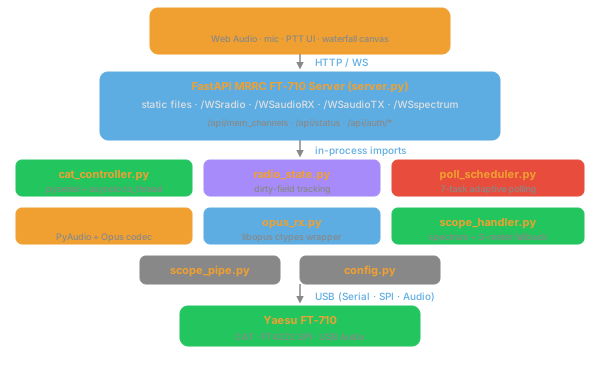
9.2 WebSocket Endpoints
9.2.1 /WSradio (JSON text)
Control channel. Carries all radio commands, state updates, and memory management.
Server → Client:
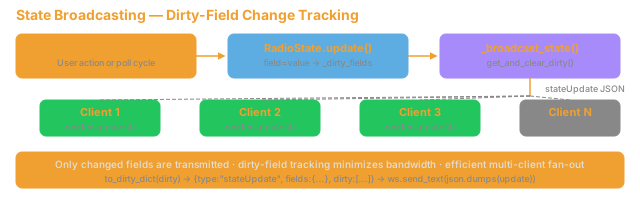
{"type":"fullState","data":{...},"bands":[...],"modes":[...]}— initial sync on connect{"type":"stateUpdate","fields":{...},"dirty":[...]}— partial changed-field update{"type":"value","field":"...","value":...}— single-value query response{"type":"memChannels","channels":[...]}— memory channel broadcast{"type":"pong"}— keepalive response
Client → Server:
{"type":"set","field":"...","value":...}— command (40+ supported fields){"type":"get","field":"..."}— query current value{"type":"memSave","channels":[...]}— save memory channels{"type":"memDelete","index":N}— delete memory slot{"type":"ping"}— keepalive
9.2.2 /WSaudioRX (binary)
Format: 1-byte codec tag (0x00=PCM, 0x01=Opus) + payload.
Server captures 48kHz Int16 mono from FT-710 USB audio → Opus encodes (64kbps default) → broadcasts to all audio_rx_clients at 20ms intervals. Browser decodes via WASM OpusDecoder (or Int16→Float32 for PCM) → AudioWorklet playback with jitter buffer.
9.2.3 /WSaudioTX (binary + text)
Binary: 1-byte codec tag + encoded mic audio. Server decodes (Opus→PCM or pass-through PCM) → queues to PyAudio output stream → played to FT-710 USB audio input.
Text: "s:" = stop TX; "m:rate,encode,..." = settings.
9.2.4 /WSspectrum (binary)
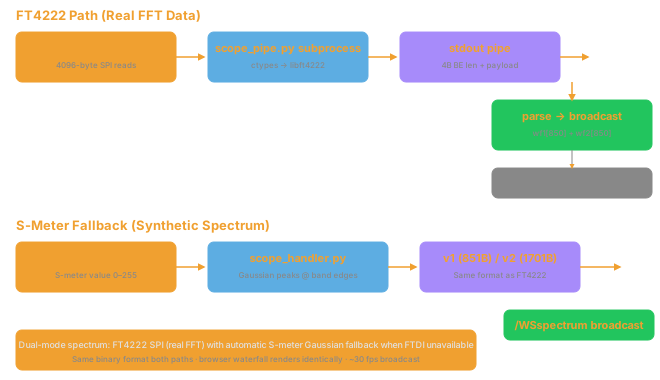
v1 format: 1-byte version (0x01) + 850 bytes wf1 = 851 bytes. v2 format: 1-byte version (0x02) + 850 bytes wf1 + 850 bytes wf2 = 1701 bytes.
Broadcast at ~30 fps from FT4222 data or S-meter fallback.
9.3 RX Audio Signal Chain
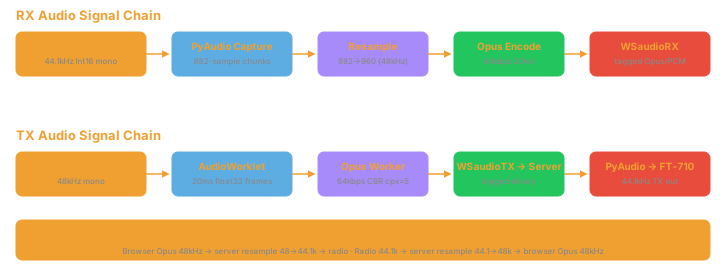
See upper half of diagram.
9.4 TX Audio Signal Chain
See lower half of diagram.
TX runs at 48 kHz throughout the codec domain — browser capture and Opus encode/decode — and the server bridges to the FT-710’s native 44.1 kHz USB audio via frame-aligned resampling (960↔︎882 = exactly 20 ms, ratio 160:147) on every platform, including Windows. This eliminates the v1.0 sample-rate mismatch (16 kHz mic → 48 kHz playback) and prevents a Windows shared-mode mix rate from bypassing the device-domain bridge.
The 44.1 kHz playback queue pre-buffers 60 ms and caps latency at 400 ms. Oldest-frame drops at that cap are counted as queue_drops in the per-PTT session log alongside received, decoded, written, write-error, peak, and non-owner counters. A healthy Windows RF acceptance run therefore requires decode_fail=0, write_err=0, queue_drops=0, and non_owner_drops=0; sustained queue drops identify a host-output pacing problem even when Opus decoding succeeds.
9.5 Spectrum Signal Chain
9.5.1 FT4222 Path (Real FFT Data)
9.5.2 S-Meter Fallback (Synthetic Spectrum)
See lower half of spectrum diagram.
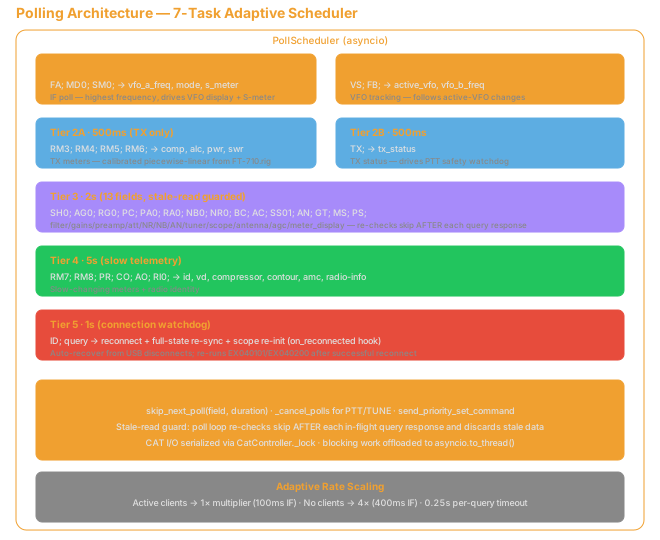
9.6 CAT Polling Architecture
9.7 State Broadcasting
9.8 ATR1000 Tuner Linkage (optional)
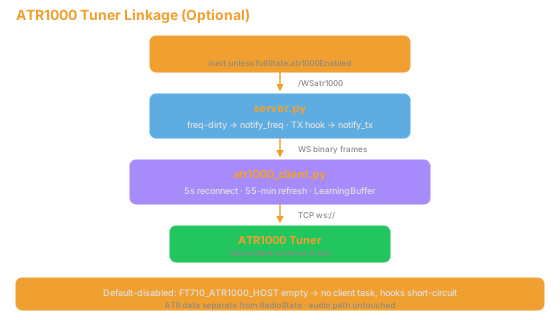
Three linkage behaviors:
- Freq change → relay apply —
_broadcast_stateon vfo_a_freq/vfo_b_freq/active_vfo dirty callsnotify_freq; learned LC values fromatr1000_tuner.json(TunerStorage: learn gate SWR 1.0–1.8, 1kHz keys ±5kHz nearest, atomic writes) are pushed to the tuner (5s write throttle). - TX on/off →
notify_tx— switches the tuner to device push mode and opens the learning window (LearningBuffer, 4-sample stability). - Tune assist — client
{"type":"atrTune"}runs_atr_tune_assist()server-side: TX2 carrier → skip if SWR≤1.6 → snapshot relays → full tune (mode=2) → keep+learn if SWR improved ≥0.02 else rollback → carrier always dropped infinally(ATR_TUNE_* constants: 0.3s settle, 5s min, 45s deadline, 0.8s compare settle, 2.5s meter wait).
Default-disabled isolation: FT710_ATR1000_HOST empty (default) means no client task, no network traffic, linkage hooks short-circuit, /WSatr1000 closes with code 4000, and the frontend module is never initialized. ATR data is deliberately kept out of RadioState (separate channel, same precedent as spectrum); the audio path is untouched.