Before the Thinking.
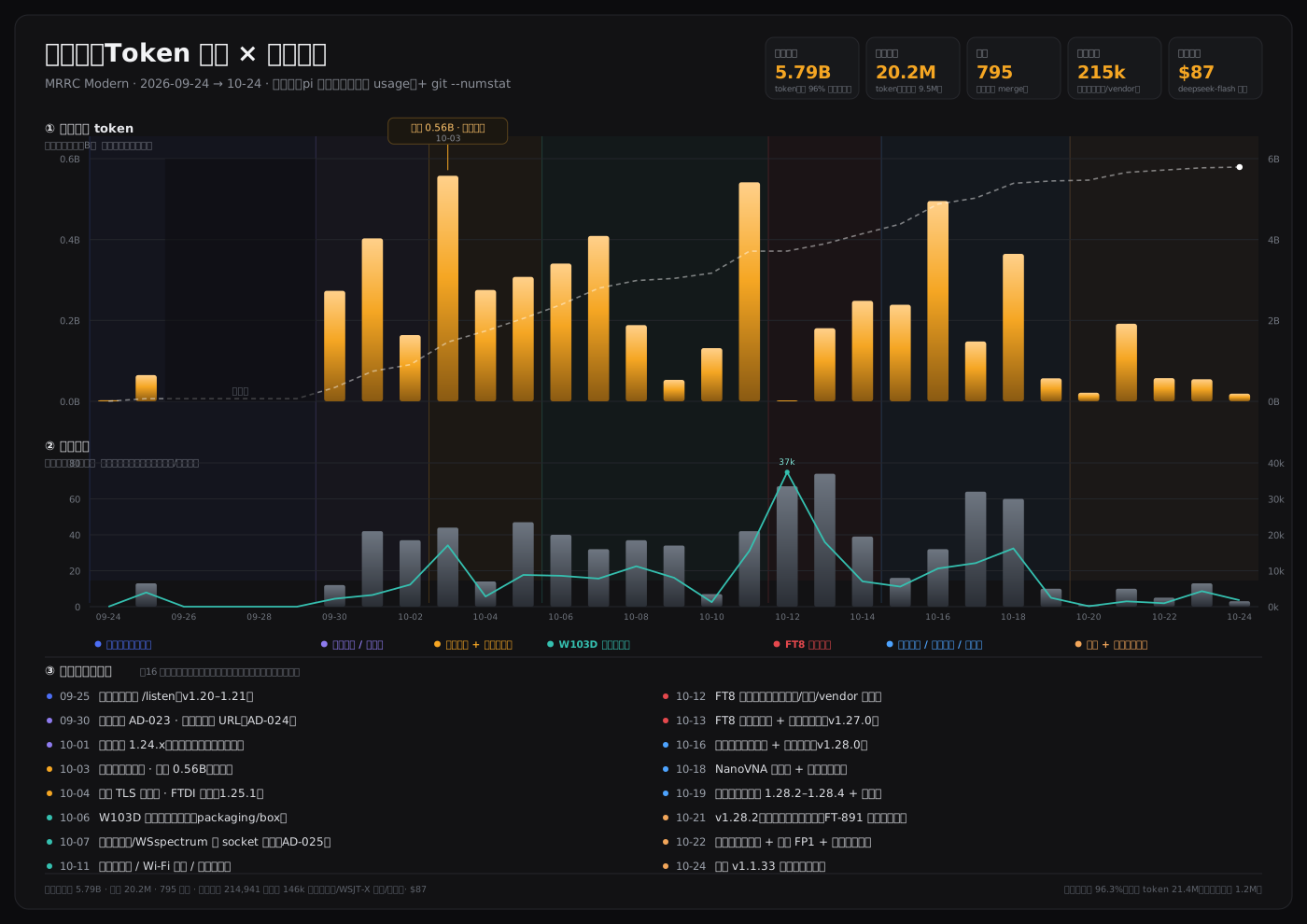
Thirty-one days, 5.79 billion tokens, 795 commits, sixteen shipped milestones. The previous ledger covered seven months; this one covers one. Set side by side they say something. Added together they say nothing — the boundary moved.
The full article — with the daily curves, the milestone list and the excluded list — is written in Chinese. This page carries the method and the numbers, so the English index does not point at a 404.
Two books, no division
Where the numbers come from, and what they are not.
Token counts are the usage record carried by every assistant message in the
session logs, bucketed by that message's own timestamp. Code counts are
git log --numstat over the same window, with vendored trees, the callsign
database and generated weight tables subtracted. Nothing here is estimated.
| Window 2026-09-24 → 10-24 | Value | Note |
|---|---|---|
| Sessions / prompts | 91 / 1,346 | one machine, one working tree |
| Input (uncached) | 132.1M | newly read material |
| Model output | 20.18M | plus 9.47M reasoning |
| Cache re-read | 5.57B | 96.3% of the total |
| Processed total | 5.79B | input + output + re-read |
| Recorded cost | $86.8 | per-message pricing, not a bill |
| Commits / readable lines added | 795 / 214,941 | 361,293 before exclusions |
The honest objection is that counting cache re-reads inflates the total. It does. The table keeps the three components apart so a reader can pick their own denominator.
The peaks do not coincide
Spend lands on deciding days; lines land afterwards.
The four token peaks of the month — 09-30, 10-03, 10-11, 10-16 — are design, kickoff, image-line and support-loop days. The four commit peaks — 10-12, 10-13, 10-17, 10-18 — come after. On 10-03 the token count hit its monthly maximum of 558M on the day the Android client started; commits that day did not crack the top ten.
Read as an engineering statement rather than a curiosity: deciding costs context, appending does not. The cheap way to lower the next month's bill is not shorter prompts but shorter sessions — specs, guards and tests that let the next session start clean.